
Marijampolė became an urban area quite late, so the data on the arrival of Jews or creation of their community date only from the second half of the 18th century. A new town, established in the area of the Starapolė village, attracted Jews from the neighbourhood places. It is most likely that, with the encouragement of Countess Francis Butlerienė, the Jews from nearby Kalvarija gradually settled in Marijampolė.
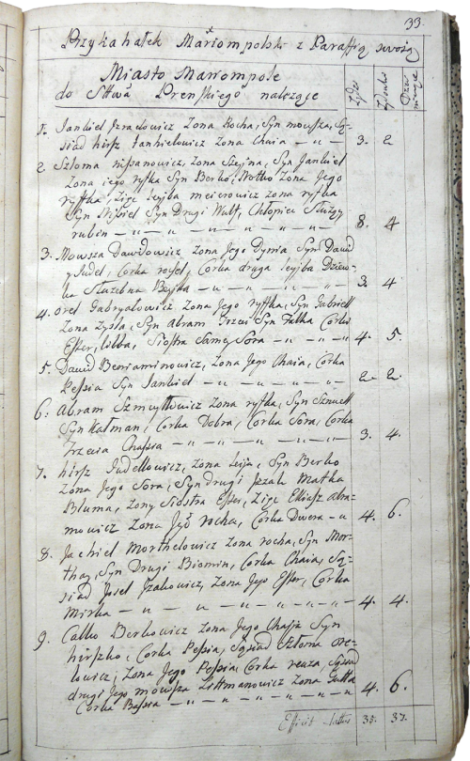
More reliable data about the number of Jews in the Grand Duchy of Lithuania and in Marijampolė, is based on the census of Jews issued by the Seimas of the Commonwealth of the Two Nations in 1764 and executed in the first half of 1765. The sources of this census prove the establishment of a comparatively large and organized community of Jews in Marijampolė.
According to the 1764 census data, there were 344 Jews (also including Jews from Kaunas) – men and women over one year of age (babies were not included in the census due to their high mortality). However, only a part (289) of the Jews belonging to the Marijampolė community lived in the city, forming 52 independent households (hosts with unmarried children, servants and lodger families). It is very likely that the community of Jews made almost half of the residents of Marijampolė. A family of eight persons was located in an unspecified village near Marijampolė, within the area of community influence, and another 47 Jews lived, as tenants, in the eight surrounding inns, which belonged to local nobles or the church.
It was common that Jews did not want to compete with each other, thus, members of the Jewish community were looking for alternative places to work and live. If they managed in the way that the Jews of the Marijampolė community did – in the surrounding villages and inns, if not – members of the community could live quite a long distance from the community to which they belonged or looked for new places to settle.
The census data about Marijampolė Jews, unlike the data from other places of the Grand Duchy of Lithuania, does not provide information about professional activities of the Jews from Marijampolė as well as the streets or places inhabited by them. It is to be assumed that the Jews settled in the central part of the town, near or around the market square, near the roads leading to Vilnius and Warsaw.
The status of Marijampolė Jewish community – prekahal was mentioned in the census. What does that mean? Prekahals were less numerous or less influential communities located near the kahal, a higher community in rank with an elected self-governing body. Prekahals, indirectly but through kahal, usually paid taxes to the state or Jewish self-governing institutions. They also addressed the kahal in cases of a dispute to be solved under religious law. Prekahals had permanent or temporary access to the kahal‘s confessional infrastructure such as cemeteries, if they had not had any in their disposition. Since 1780 first known rabbi, Chaim Perelmuter, was the head of Marijampolė community and he held the office for almost four decades.
The Jewish community of Marijampolė grew dramatically in the 19th century, and between 1851 and 1860 the number of Jews exceeded three thousand, which was 81-82 % of all Marijampolė population. So it is not surprising that such a large community needed as many as three synagogues to meet the religious and community needs. However, during interwar period, the number of Jews decreased significantly due to the compulsory eviction of Jews from the border territories taken over by the Russian Empire during World War I, and after the war not everyone returned to the places previously inhabited. The first general census of the population of the restored Republic of Lithuania, which took place in 1923, recorded the residence of 254 Jews in Marijampolė, representing approximately 27 % of the total population.
The names of two streets of historic Marijampolė were directly associated with Jews and proved that a large community lived here –Žydų (Jews) and Sinagogos (Synagogue) (the latter had a Polish version of the name – ulica Boźnicna and the Russian – Synagogalnaia). These are the most common streets associated with the residence of Jews in a city not only in Lithuania but also in other parts of Europe. Jews Street was in almost every city in Lithuania. The name of the Synagogue street in Marijampolė was given to a small street facing the north, leading to J. Dailide Street. The street is small, so, though in the 19th century it was called Synagogue Street, later it became only a bystreet. During the interwar period there were attempts to rename Synagogue Street to Kurpiai Street or bystreet but the name was not approved. Today it is Senoji Street, in the central part of the city, between the present streets of Senoji and Kaunas. There was the shulhoyf (Yiddish) of Marijampolė community – the courtyard of the synagogues, with two synagogues (Senoji st. 1 and Kaunas st. 4) and the centre of community and religious life.